The Real Cost of Using Multiple Course Authoring Tools
Eight tools to do four jobs. Here's the honest cost — and a 30-minute audit to map your own stack.

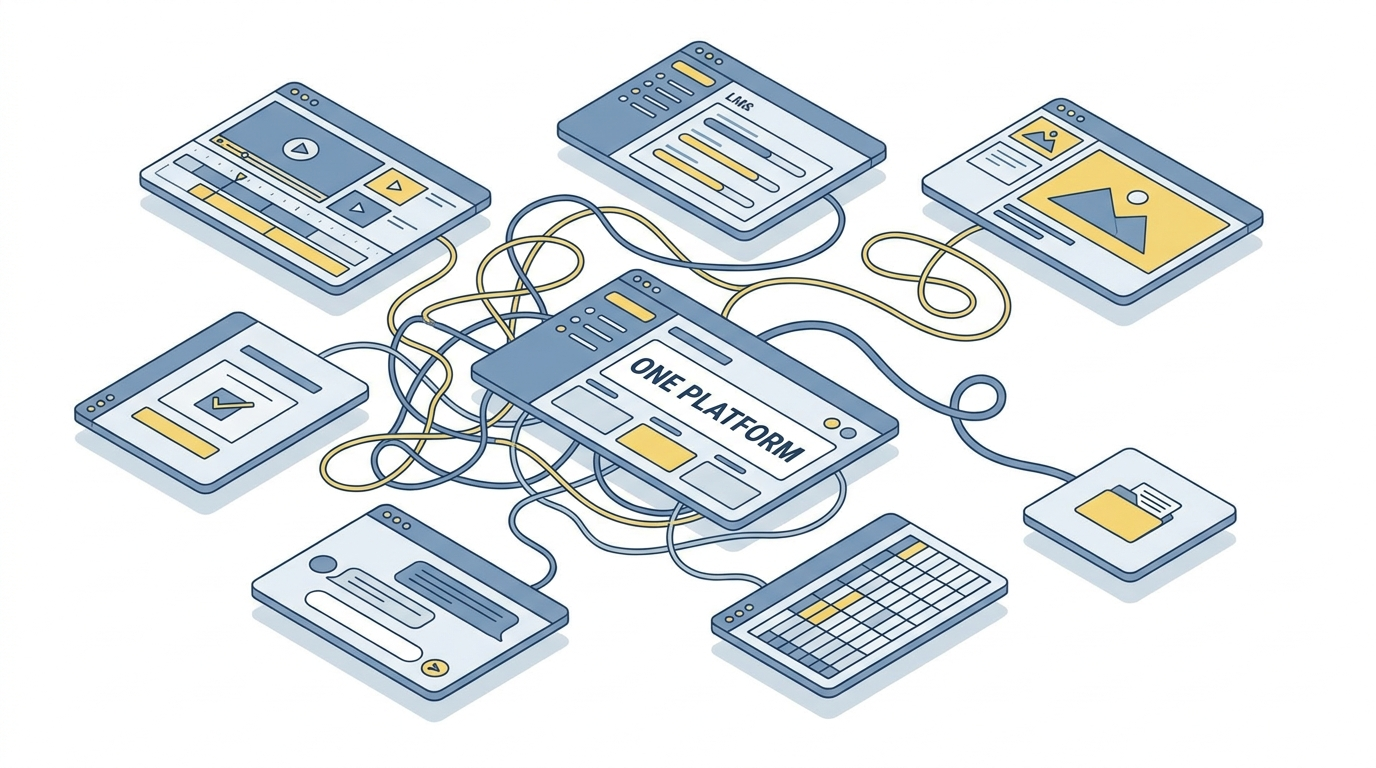
Course Authoring Tool Sprawl: Why It's Costing L&D Teams More Than They Think
Every L&D team I talk to is using five to seven different tools to do what should be one job: build a training course, deliver it to employees, and know whether it worked.
Articulate Rise for authoring. Camtasia for screen recording. Loom for quick walkthroughs. An LMS for hosting and tracking. Google Drive for assets. Slack for coordination. A separate survey tool for feedback. Sometimes ChatGPT in a tab for content generation.
This is normal. It's also expensive in ways that don't show up on the invoice.
I've spent fifteen years building learning platforms, first at EdEra and now at Workademy. The single most common operational complaint I hear from L&D leaders isn't about content quality, learner engagement, or even budget. It's the tool sprawl. The hours lost to context-switching. The version-control chaos. The integration that broke again. The institutional knowledge that walked out the door with the contractor who knew where everything was stored.
This article is for L&D teams who suspect their stack is working against them but can't quite quantify the cost. Here's an honest look at the problem and a practical way to think about consolidation.
The 7-tool reality of modern course creation
Let's start with what a typical mid-sized company's training stack actually looks like in 2026.
Authoring layer: Articulate Rise or Storyline for SCORM courses. Camtasia or Loom for screen recordings. Canva for slides and quick visuals. ChatGPT or Claude for drafting copy and quiz questions.
Delivery layer: An LMS to host courses, assign them to people, track completion. Sometimes a separate LXP for self-directed content. A separate compliance tracking spreadsheet because the LMS reporting isn't quite what auditors need.
Coordination layer: Google Drive or SharePoint for raw assets and source files. Slack or Teams for cross-functional handoffs with subject matter experts. Asana, Notion, or a spreadsheet to track which courses are scheduled for development.
Feedback layer: SurveyMonkey or Typeform for post-training surveys. The LMS's built-in feedback if it has one. Maybe a Google Form for quick pulse checks.
Analytics layer: The LMS's reporting dashboard. Maybe a BI tool pulling LMS data into Power BI or Looker. Often, an Excel sheet that someone manually updates.
Count those up: eight to twelve tools, depending on how granular you want to get. Most L&D teams aren't using all of them, but they're using six or seven on any given day. The cost of each one individually feels small. The combined cost is what hurts.
The hidden costs nobody puts on the invoice
The licensing fees are the visible part of the iceberg. The real cost shows up in places you don't think to measure.
Context-switching costs. Research on focused knowledge work consistently finds that each tool switch costs around 15-20 minutes of recovery time before you're back to full productivity. An L&D specialist switching between seven tools in an afternoon isn't doing seven small switches — they're losing roughly an hour and a half of cognitive work to transitions alone. For a team of three, that's a full workday per week. Per person.
Version-control chaos. "Is Module 3 v4 the latest? Or is it v4_final, or v4_FINAL_olga_edits?" Anyone who has worked in L&D knows this conversation. When source assets live in Google Drive, exports live in the authoring tool, and the delivered version lives in the LMS, there's no single source of truth. Updates get applied to the wrong file. Learners see outdated content. Compliance audits get nervous.
Integration debt. Each tool connection — LMS to HRIS, LMS to Slack, authoring tool to LMS — is a piece of software that someone has to maintain. Most of these integrations are built on Zapier or a vendor's "we have an integration" button that turns out to be brittle. When the integration breaks (and it will), one of three things happens: someone notices and patches it, nobody notices and bad data flows for weeks, or the integration gets quietly abandoned and the team reverts to manual exports.
Knowledge silos when staff turnover happens. This is the cost that hurts most when it lands. When the L&D coordinator who knew where everything lived leaves the company, their successor inherits a maze. Which tool has the latest version of the onboarding flow? Where are the source PowerPoints? What's the password to the Camtasia license? Three months of onboarding gets eaten by archaeology.
These costs are real, but they're also invisible to procurement. They never show up in the line-item budget review. The first time anyone notices them is when an audit fails, a launch slips, or someone resigns.
Where the fragmentation actually starts
It's tempting to blame L&D teams for stack sprawl, but the fragmentation isn't really their choice. It comes from three structural pressures, and they're worth naming.
The best-of-breed myth. Every L&D vendor's website says "best-in-class" for their specific function. The implicit promise is that if you assemble the best authoring tool with the best LMS with the best survey tool, you'll get the best stack. In practice, "best-in-class" means "deepest features for this specific job" — which usually means the most complexity and the most assumptions about how you should work. Five best-in-class tools don't combine into a coherent workflow. They combine into five separate workflows you have to bridge yourself.
Vendor lock-in patterns. Once a team has built 50 courses in Articulate Rise, switching authoring tools means re-authoring 50 courses. So they don't. Then the LMS contract comes up for renewal — but the LMS has been integrated with five other tools, so switching it means rebuilding five integrations. So they don't. The stack accretes through individual decisions that each made sense at the time, and there's no point at which it makes sense to step back and redesign from scratch.
Procurement processes that reward narrow scopes. Buying one tool that does one thing well is easier to justify than buying a platform that does many things adequately. The narrow purchase passes procurement faster, has clearer ROI, and faces less internal resistance. So the path of least resistance is always one more tool, never one platform that consolidates.
Understanding this matters because it means the problem isn't laziness or bad taste. It's that the industry's incentive structures push every L&D team toward sprawl, and the cost only shows up after it's hard to undo.
The four-tool minimum: what you actually need
Strip the stack down to first principles. What does an L&D team genuinely need to do?
They need to create content — written copy, visuals, video, interactive elements. They need to deliver content — assign it to specific people, host it, give them an interface to consume it. They need to track and prove — who finished what, when, how well, with audit logs that hold up in a compliance review. They need to gather feedback and improve — surveys, learner behavior data, completion funnels.
That's four jobs. The honest minimum stack is four tools — one for each.
The reason most L&D teams have seven is that each "tool for one job" was actually a tool for half a job, requiring a second tool to complete it. Articulate creates courses but doesn't host them, so you need an LMS. The LMS tracks completions but doesn't analyze drop-off patterns, so you need a separate analytics layer. The LMS has built-in surveys but they're limited, so you also use Typeform. Each gap creates another tool, and each tool creates another handoff.
Going from seven tools to four isn't about removing capability. It's about choosing tools that handle complete jobs rather than partial ones. This is the same logic behind scaling corporate training without sacrificing quality — the bottleneck isn't capability, it's coordination overhead.
Curious how Workademy handles all four jobs in one platform? Book a 30-minute call and I'll walk you through it on your specific use case. No pitch — just an honest look at whether consolidation makes sense for you.
The case for consolidation — and the honest case against
I run a platform that consolidates several of these jobs, so this is the section where my bias is most obvious. Let me try to be fair to both sides.
The case for consolidation is straightforward. Fewer tools mean less context-switching, less version-control chaos, less integration debt, and less knowledge fragility. Onboarding new L&D team members is faster because they learn one platform instead of seven. Audit trails are coherent because they live in one system. Total cost of ownership is usually lower, because the licensing savings come bundled with the operational savings.
The case against consolidation is less obvious but real. If your team has deep expertise in a specific best-of-breed tool — say, ten years of Articulate Rise experience — that expertise is an asset, and switching means writing off that asset. If you have specialized needs that a consolidated platform doesn't cover (very advanced branching scenarios, complex SCORM packaging for external distribution, simulation training), you'll need specialized tools no matter what. And if your existing stack is working — even if it's seven tools — the cost of change might genuinely exceed the cost of the status quo.
The decision isn't "consolidated platforms are better." It's "which model fits your situation." This is the same tension that shows up in the LMS vs LXP debate — the question isn't which category is superior, it's which one solves the problem you actually have.
A 50-person company with no dedicated L&D team and no legacy stack should almost certainly consolidate. A 2,000-person enterprise with a sophisticated L&D function and ten years of process built around specialized tools probably shouldn't.
Most companies sit in between, and for them the question is which parts of the stack to consolidate first.
A 30-minute audit to map your current stack
Before you change anything, map what you actually have. Here's the audit I recommend, which takes about half an hour for most teams.
Step 1: List every tool that touches a course in its lifecycle. From the moment someone says "we need training on X" to the moment a learner finishes it. Don't filter — include the spreadsheets and the Slack channels and the personal Notion docs.
Step 2: For each tool, write down (a) what it does for you, (b) annual cost, (c) the named owner. If a tool has no named owner, that's a finding. Orphan tools are where institutional knowledge dies.
Step 3: Map the handoffs. Draw arrows showing where data moves from one tool to another. For each arrow, note whether it's automatic, semi-automatic (someone clicks export and import), or manual (someone retypes).
Step 4: Count the manual arrows. Each one is a place where the workflow breaks when the person who knows the steps is on vacation. These are your priority consolidation targets — not the most expensive tools, but the ones with the most fragile handoffs.
Step 5: Ask the people doing the work. What takes longest? What breaks most often? Where do they wish there were one fewer step? The answers will surprise you. The most expensive tool is rarely the most painful one.
You can do this on a whiteboard, in a doc, in a spreadsheet. The format doesn't matter. What matters is making the stack visible, because most L&D teams have never actually mapped it.
What Workademy does differently — and where it won't fit
I'll be brief and honest here.
Workademy consolidates the create-deliver-track-improve loop into one platform with AI doing the heavy lifting on content creation. We're the right fit when an L&D team is small or non-existent, the company has mandatory training to deliver (onboarding, compliance, product), and the cost of context-switching across multiple tools has become real. Our customers tend to be companies in the 50-500 employee range with no dedicated L&D function, or with one L&D specialist who is drowning.
We're the wrong fit when the company has a sophisticated L&D function with deep expertise in specialized authoring tools, when the training needs include simulations or complex branching scenarios that go beyond standard course structures, or when SCORM exports for external distribution are a primary requirement. We don't pretend to solve every problem, and we're transparent with prospects about cases where another tool is better. If you're not sure which side of that line you sit on, the AI vs traditional LMS comparison is a good place to start.
The conversation worth having isn't "should you switch to Workademy." It's "is your current stack costing you more than you realize, and if so, what would the right consolidation look like." Sometimes the answer is us. Sometimes it's a different consolidation pattern. Sometimes it's keeping what you have but fixing one specific painful handoff.
Want to think through your stack with someone who's not selling you a license? Book a 30-minute intro call and we'll work through your specific situation. If the right answer isn't Workademy, I'll tell you that.
The L&D tool stack you have today is the accumulation of small, sensible decisions made over years. The cost has accumulated the same way — quietly, decision by decision, until the totals are surprising.
You don't have to consolidate everything at once. You don't have to consolidate at all if it doesn't make sense for your situation. But you should map what you have, count the hidden costs, and decide deliberately rather than by inertia. That's the difference between a stack that grows because it's working and one that grows because no one ever looked at it.
Olga Filipova is the founder of Workademy, an AI-powered LMS for growing teams, and the author of "Learning Vue.js 2" (Packt Publishing). She has 15+ years of experience in software engineering and EdTech.